A plausible answer is not the same as a supported one. CYPHR turns uploaded documents into a searchable knowledge base and brings source-file and page citations into the chat experience.
01Illustrative retrieval flow · sample data, not a benchmark
Source: audit_report_2025.pdfp. 14
// Example source passage • Chunk #42
“...Operating margins in Q3 reached 28.4%, representing a 14% efficiency gain in internal search operations. The transition from sparse keyword search to localized dense vector retrieval reduced query latency from 320ms to 18ms across all enterprise tenants... Overall cash flow remains steady.”
1024-D Vector Match
Cosine: 0.894Latency: 18ms
CYPHR Cited AnswerSource Cited
In Q3, operating margins expanded to 28.4%, driven by a 14% operational efficiency gain following the deployment of localized dense vector retrieval, which decreased search latency to 18ms.
Follow one document through the system. The diagram evolves with each chapter; the engineering story stays in ordinary reading flow.
01
01 of 05
Data Ingestion
Start with the source material.
User-uploaded PDFs are extracted, divided into passages, embedded and indexed before retrieval. Source file and page metadata travel with each passage.
Uploaded PDFSource-tagged passages
InputUploaded PDFs
PreparationChunked passages
ProvenanceSource file + page
Project Evidence
A retrieval-augmented chat platform that answers strictly from documents you upload. PDFs are extracted, chunked and embedded into MongoDB Atlas vector search; every answer cites the source file and page it came from.
PDF ExtractionPassage ChunkingSource Metadata
tenant / authenticated
source.pdf 01file + page / retained
source.pdf 02file + page / retained
source.pdf 03file + page / retained
passage / 41source.pdf · p.14
passage / 42source.pdf · p.14
passage / 43source.pdf · p.14
passage / 44source.pdf · p.14
query
1024-D
cosine
context
model
source
Grounded answer
source.pdf / page 14
provenance is never discarded
The document is the beginning. File and page metadata stay attached.
Six configurable LLM providers let the user choose a model at runtime. Retrieved passages supply the context for document-grounded answers with source citations.
Retrieved passagesRuntime model choice
Model Routing6 Dynamic Providers
SelectionRuntime model choice
GroundingRetrieved document context
Project Evidence
Configurable LLM providers with runtime model selection
6 ProvidersDynamic RoutingStrict Grounding
tenant / authenticated
source.pdf 01file + page / retained
source.pdf 02file + page / retained
source.pdf 03file + page / retained
passage / 41source.pdf · p.14
passage / 42source.pdf · p.14
passage / 43source.pdf · p.14
passage / 44source.pdf · p.14
query
1024-D
cosine
context
model
source
Grounded answer
source.pdf / page 14
provenance is never discarded
Retrieved context travels to the model selected at runtime.
Illustrative · cyphr/orchestrator/router.ts
const response = await modelRouter.generate({
  provider: userSettings.provider,
  context: retrievedPassages,
  instruction: "Answer strictly from context. Cite [File, Page] on every claim."
});
Next: Client Interface
05
05 of 05
Client Interface
Make confidence visible.
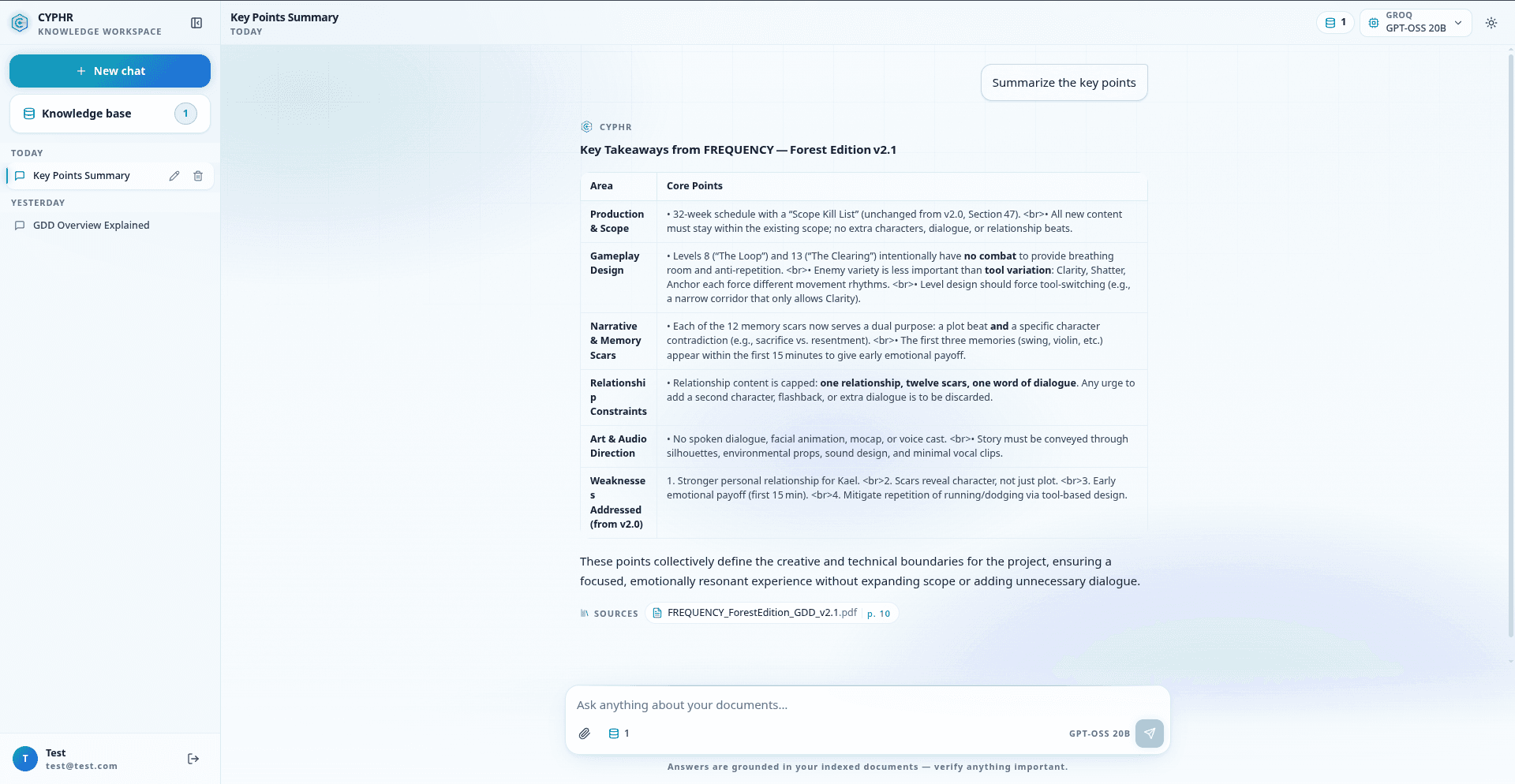
React presents a chat workspace with source-file and page citations, helping the reader check an answer against the uploaded material.
Grounded answerFile + page citation
FrontendReact chat workspace
CitationsSource file + page
VerificationDocument provenance
Project Evidence
A retrieval-augmented chat platform that answers strictly from documents you upload. PDFs are extracted, chunked and embedded into MongoDB Atlas vector search; every answer cites the source file and page it came from.
ReactCitationsChat Workspace
tenant / authenticated
source.pdf 01file + page / retained
source.pdf 02file + page / retained
source.pdf 03file + page / retained
passage / 41source.pdf · p.14
passage / 42source.pdf · p.14
passage / 43source.pdf · p.14
passage / 44source.pdf · p.14
query
1024-D
cosine
context
model
source
Grounded answer
source.pdf / page 14
provenance is never discarded
The answer carries a citation back to the original file and page.